Architectural Sourcing Whitepaper: The Evolution of Large-Format Pivot Door Systems
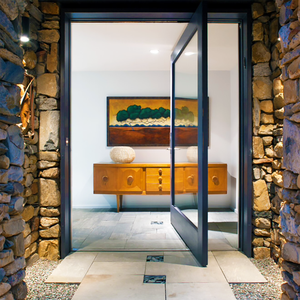
Modern high-end architectural design has shifted dramatically toward large-scale building openings, uninterrupted floor-to-ceiling glass, and grand entrance portals. Traditional side-hinged doors are mechanically limited when handling panel weights above 150kg due to cantilevered hinge stress on vertical jambs. Architectural pivot doors overcome these physical structural limits by transferring vertical loads directly downward into the structural floor slab using a specialized offset floor pivot hinge pin assembly.
China has established itself as the global manufacturing hub for custom architectural pivot doors. Leading Guangdong factories combine competitive aluminium extrusion capacity, advanced multi-axis CNC milling, and certified glass laminating facilities. However, international B2B importers, general contractors, and developers must understand the technical specifications, procurement trends, and structural nuances required to successfully source high-performance pivot doors from Chinese suppliers.
1. Structural Kinematics & Pivot Hinge Metallurgy
The core structural component of any oversized pivot door is its pivot axis system. Unlike standard butt hinges, pivot hardware carries rotational and vertical dead loads simultaneously. High-grade systems manufactured in top Chinese factories utilize the following engineering approaches:
- Heavy-Duty Hydraulic Floor Springs: Built-in oil-pressurized dampening mechanisms provide controlled closing speeds, latching speeds, and backcheck functions to prevent doors from slamming under wind loads.
- Concealed Top Pivot Spindles: Precision-milled 304/316 stainless steel top pins with integrated needle bearings ensure low-friction rotation and eliminate frame distortion.
- Load Capacity Ratings: Industrial pivot hinges are rated for specific weight bands—400kg, 600kg, 800kg, and up to 1500kg. Exceeding these engineering thresholds causes hinge creep, bottom threshold drag, and seal degradation.
- Adjustable 3D Alignment Mechanisms: Precision adjustment screws allow installed panels to be fine-tuned along the X, Y, and Z axes (±5mm) to compensate for minor building settling or concrete floor unevenness.
2. Thermal Break Engineering & Glazing Mechanics
Large pivot doors present thermal challenge risks if non-thermal aluminum profiles are used in cold or extremely hot climates. Premier Chinese exporters utilize structural thermal-break extrusion profiles featuring polyamide PA66 GF25 (25% glass-fiber reinforced) struts to separate interior and exterior aluminum chambers.
In terms of glazing, oversized pivot doors demand laminated or toughened insulated glass units (IGU) designed to withstand high deflection forces:
- Tempered Impact Glass: Minimum 8mm to 12mm single-pane tempered glass, or 6mm+12Ar+6mm double Low-E configurations.
- Hurricane Laminated Glass: For coastal regions (e.g., Florida, Caribbean, Australia), profiles incorporate 1.52mm or 2.28mm SentryGlas® (SGP) interlayer films between tempered glass panes to meet severe impact and cyclic wind pressure tests.
- Vacuum Insulated Glass (VIG): Advanced developments include integrating ultra-thin VIG panels into narrow pivot frames to achieve passive house thermal insulation standards (U-values below 0.6 W/m²K).
| Material Profile Type | Max Panel Height | Thermal U-Factor (W/m²K) | Wind Load Resistance | Ideal Application |
|---|---|---|---|---|
| Non-Thermal Aluminum 6063-T6 | 4000 mm | 5.2 - 5.8 | Class 4 (2000 Pa) | Interior Partitions / Warm Climates |
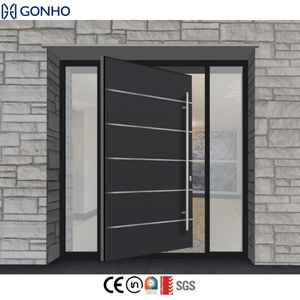
| Thermal Break Aluminum (PA66 Strip) | 6000 mm | 1.4 - 2.2 | Class 5 (3500 Pa) | Luxury Exterior Entrances |
| Hurricane Impact Thermal Break | 4500 mm | 1.6 - 2.4 | Miami-Dade HVHZ (±90 PSF) | Coastal Villas & High-Rise Towers |
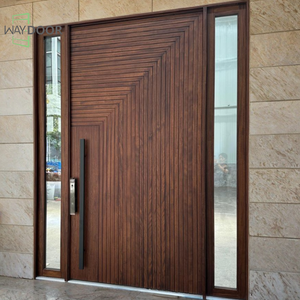
| Engineered Solid Wood + Steel Core | 3500 mm | 1.1 - 1.5 | Class 3 (1500 Pa) | High-End Residential Portals |
Global Sourcing & Procurement Trends (2025–2030)
The global market for large-format architectural pivot doors is experiencing structural evolution. B2B purchasers, building material distributors, and real estate developers are shifting their procurement strategies from simple price-per-square-meter purchasing to total lifecycle value, compliance verification, and digital supply chain integration.
A. Direct BIM & Digital Twin Supply Chain Integration
Modern architectural projects utilize Building Information Modeling (BIM) software (such as Autodesk Revit and ArchiCAD) during early design phases. Top-tier Chinese pivot door suppliers now provide native parametric BIM objects, allowing architects to insert fully customized pivot door assemblies into project models. This enables automatic clash detection, exact structural opening calculation, and direct conversion from design files to factory CNC code, reducing lead times by up to 30%.
B. Modular Unitized Delivery & Prefabricated Installation
On-site labor costs in North America, Europe, and Australia continue to escalate. Consequently, general contractors prefer pre-assembled, unitized pivot door systems shipped directly from factories. Modern Chinese exporters assemble frame corners, test drop-down weather seals, pre-wire smart access locks, and pre-fit floor spring cement boxes inside the factory. The entire door set arrives on site as a plug-and-play assembly, cutting jobsite installation time from days to a few hours.
C. High-Performance Sustainability & Low-Carbon Extrusions
ESG (Environmental, Social, and Governance) mandates in North America and Western Europe require building components to document low embodied carbon. Forward-thinking Chinese extruders are utilizing recycled aluminum billets (hydro-powered aluminum extrusion process) and zero-VOC powder coating finishes to satisfy LEED v4 and BREEAM environmental certification standards.
Architectural & Technological Development Trends
As architectural aesthetics lean heavily toward minimalism, maximum transparency, and smart automation, pivot door manufacturing technology is undergoing rapid innovation.
I. Ultra-Minimalist Sightlines & Invisible Concealed Frames
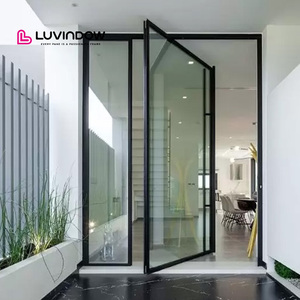
The visual barrier between interior living space and exterior surroundings is disappearing. Future pivot door designs feature outer frame profiles designed to be embedded directly into surrounding masonry, plaster, or curtain wall tracks. Visible profile widths are minimized to as little as 20mm, leaving almost pure glass exposed while maintaining high structural deflection strength.
II. Fully Automated Hydraulic & Motorized Drive Systems
As pivot door panels exceed 600kg to 1000kg, manual operation requires precise mechanical assistance. Modern luxury pivot doors integrate hidden electronic servo motors and magnetic linear drive actuators. Users can trigger door opening via smartphone apps, wall-mounted touch sensors, or automated facial recognition scanners. The door opens silently, holds open for a specified duration, and automatically seals shut via integrated multi-point motorized locking pins.
III. Advanced Biometric Access Control & Smart Home Connectivity
Traditional mechanical keys are being replaced by integrated biometric access systems concealed directly within C-shaped pull handles or frame profiles. Modern smart pivot doors feature integrated 3D facial recognition, capacitive fingerprint sensors, Bluetooth LE keyless entry, and native integration with smart home automation ecosystems (e.g., Control4, Crestron, Apple HomeKit).
IV. Dynamic Active Sealing Technologies
A historic challenge with large exterior pivot doors has been weather sealing around the top and bottom pivot axis points. Future system designs feature active pneumatic or magnetic drop-down seals. When the door closes, magnetic field triggers or mechanical actuators push twin neoprene gaskets downward and upward to seal the 10mm floor and head gaps against driving rain and wind pressures.