1. Executive Overview: Sourcing Wholesale Pivot Entry Doors from China
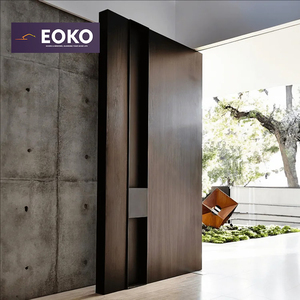
Modern architectural design is experiencing a fundamental shift toward grand, oversized entrance portals that seamlessly blend structural strength, spatial elegance, and thermal envelope performance. Among exterior opening systems, aluminum pivot entry doors stand out as the gold standard for high-end luxury villas, contemporary commercial headquarters, and hospitality developments. Unlike traditional side-hinged doors that transfer leaf weight entirely to lateral jambs, a pivot entrance door rotates on an offset vertical axis—supported by heavy-duty floor pivots and top transom pins. This engineered load distribution allows architects to specify massive door panels exceeding 3.5 meters in height and 2.0 meters in width, weighing up to 500 kilograms, without compromising smooth operation or long-term structural integrity.
As international real estate developers, general contractors, fenestration importers, and architectural specifiers evaluate global supply chains, China has cemented its position as the premier manufacturing hub for precision-engineered pivot door systems. Sourcing directly from verified OEM/ODM manufacturers like Fortor Security Door Co., Ltd. (operating out of a dedicated 20,000 square meter facility in Guangdong, China) provides B2B buyers with access to advanced aluminum extrusion alloys, European multi-point security locking, custom thermal break polyamides, and rigorous quality assurance—all achieved at competitive factory-direct wholesale pricing.
Procuring structural pivot entry doors involves navigating wind-load pressures, structural deflection limits (L/175 or L/240), air/water infiltration resistance (ASTM E283/E331), thermal transmittance (NFRC U-factors), and hardware cycling durability. This white paper breaks down the exact technical parameters required to specify, source, and import commercial-grade pivot systems from top China manufacturers.
2. Structural Anatomy & Engineering Principles of Heavy-Duty Pivot Doors
To appreciate why high-performance pivot doors outperform conventional entrance doors, procurement specialists must analyze their underlying architectural components:
Heavy-Duty Offset Pivot Hinges
Utilizing German or Italian-engineered floor springs and top pivot pins equipped with needle thrust bearings. Designed to support dynamic loads up to 500kg with adjustable self-closing, 90-degree hold-open, and anti-sagging alignment screws.
Thermal Break Profiles & Insulation
Structural aluminum frames constructed from 6063-T5/T6 alloy, combined with high-grade PA66-GF25 (25% glass fiber reinforced polyamide) thermal barriers to stop thermal conduction and prevent interior condensation.
Multi-Point Automated Locking
Equipped with 3-point to 5-point motorized or manual lock bolts that engage simultaneously along the top, bottom, and side latching edges, offering anti-burglary protection and airtight compression.
Weatherproofing Technology for Large-Scale Pivot Openings
Historically, the primary challenge associated with pivot entrance doors was air leakage and water infiltration around the bottom floor hinge. Fortor Security Door Co., Ltd. overcomes this engineering hurdle through a proprietary multi-tier perimeter sealing system:
- Automatic Drop-Down Bottom Seals: Spring-loaded acoustic and weather drop seals extend automatically when the door reaches the closed position, creating a tight rubber gasket barrier against wind-driven rain and air infiltration.
- Double/Triple Continuous EPDM Gaskets: Automotive-grade Ethylene Propylene Diene Monomer gaskets remain resilient across extreme temperature variations (-40°C to +120°C).
- Concealed Drainage Threshold Channels: Sub-floor anodized aluminum thresholds engineered with weep holes and one-way check valves channel driven water back toward the exterior.
3. Comparative Benchmark: Pivot Doors vs. Traditional Opening Systems
When planning high-end entrance fenestration, architects and procurement directors frequently evaluate pivot systems against heavy-duty French casement doors and large sliding glass assemblies. The comparative matrix below outlines key engineering performance indicators:
| Performance / Feature Benchmark | Structural Aluminum Pivot Door | Exterior Double French Door | Lift & Slide Door System |
|---|---|---|---|
| Maximum Single Leaf Height | Up to 4,500 mm (4.5 meters) | Up to 2,800 mm | Up to 3,200 mm |
| Maximum Single Leaf Width | Up to 2,200 mm (2.2 meters) | Up to 1,100 mm per leaf | Up to 3,000 mm |
| Weight Bearing Mechanism | Floor-Anchored Hydraulic Pivot Assembly | Frame Side-Mounted Butt Hinges | Bottom Track Roller Carriage |
| Structural Wind Load Resistance | High (Up to 4,500 Pa / Hurricane Zone Tested) | Moderate to High | High |
| Thermal Insulation (U-Value) | 0.8 – 1.4 W/m²K (Low-E Triple Glazed) | 1.2 – 1.8 W/m²K | 1.0 – 1.6 W/m²K |
| Aesthetic Statement & Clearance | Grand 100% Flush Pivot Axis Impact | Classic Traditional Double Clearance | Modern Horizontal View Frame |
4. Future Sourcing & Manufacturing Trends (2025–2030)
As the global building industry moves toward smart integration, carbon neutrality, and standardized prefab construction, pivot entry door manufacturing in China is rapidly evolving. B2B buyers looking to maintain a competitive advantage should prioritize suppliers investing in the following future procurement trends:
Trend 1: Smart Access Control & Motorized Biometric Actuation
Modern commercial projects and luxury single-family homes increasingly demand hands-free access control. Future-proof pivot doors incorporate hidden electromechanical locks, embedded facial recognition cameras, biometric fingerprint sensors, and smart home integration via Zigbee, Matter, or RS485 protocols. Motorized pivot operators can smoothly swing open 300kg door leafs with touchless activation.
Trend 2: Ultra-Minimalist Sightlines & Hybrid Material Inlays
Architectural preferences are shifting away from bulky aluminum frames toward ultra-narrow perimeter stiles (visible aluminum frame under 25mm). Furthermore, manufacturers are fusing thermal break aluminum structural core frames with high-end surface finishes, including sintered stone slabs, solid walnut/oak timber veneers, forged wrought iron motifs, and anti-fingerprint anodized copper finishes.
Trend 3: Stringent Energy Efficiency & NFRC / AS2047 Certification
Energy building codes across North America (IECC standard), Australia (NCC / AS 2047 standard), and Europe (CE / EN 14351-1) are becoming increasingly strict. Sourcing factories must provide verifiable test reports for U-Factor, Solar Heat Gain Coefficient (SHGC), and Visible Transmittance (VT). Leading Chinese manufacturers now incorporate triple-pane insulated units with warm-edge spacers, argon gas fill, and dual Low-E coatings to meet passive house criteria.
With over 17 years of specialized manufacturing experience, Fortor operates a 20,000㎡ production facility equipped with high-precision CNC machining centers, automated corner-crimping machines, and a rigorous 100% pre-shipment dry-fit testing laboratory. Serving B2B clients across 30+ countries, Fortor provides BIM/CAD drawing support, custom OEM profile extrusion, and comprehensive export packaging.
5. Step-by-Step B2B Procurement & OEM Sourcing Workflow
To streamline international sourcing and mitigate project risks, professional importers follow a structured factory collaboration workflow:
Step 01
Specification & Drawing Review
Submit rough opening dimensions (RO), CAD elevation drawings, desired opening direction, glass specs (double/triple Low-E), and wind load requirements to the manufacturer's engineering team.
Step 02
Shop Drawing Approval & Prototyping
Factory engineers issue detailed 2D/3D shop drawings detailing section profiles, pivot hardware placement, threshold drainage, and anchor points for formal client sign-off.
Step 03
CNC Machining & Assembly
Aluminum extrusions are cut and machined using 5-axis CNC equipment, powder-coated or anodized, assembled with thermal break polyamides, and fitted with double-glazed glass panels.
Step 04
Quality Audit & Dry-Assembly
Every pivot entry door undergoes 100% full-frame pre-assembly in the factory to test pivot balance, latch alignment, motorized locking functions, and seal compression before crating.
Step 05
Export Wooden Crating & Logistics
Finished doors are encased in fully enclosed fumigated plywood crates with corner guards, protective film, and moisture absorbers for safe ocean freight transport.
6. Frequently Asked Questions (B2B Sourcing FAQ)
Partner with China's Premier Wholesale Pivot Door Manufacturer
Transform your residential and commercial project portals with factory-direct, thermally broken aluminum pivot doors. Contact our engineering team today for technical support, CAD shop drawings, and wholesale pricing.
Get a Quote