Featured Designer Entry & Architectural Front Door Systems
Factory-direct custom door solutions precision-engineered for commercial storefronts, luxury residential villas, multi-family developments, and coastal projects.
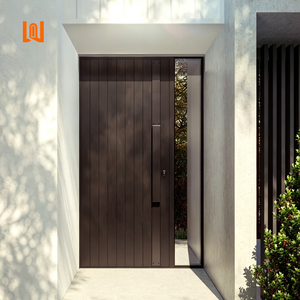
American Design Metal Aluminum Front Entry Security Door
Modern architectural exterior security entry door combining extruded 6063-T6 aluminum structural framing with custom metal paneling. Engineered for premium thermal barrier performance and high wind-load resistance.
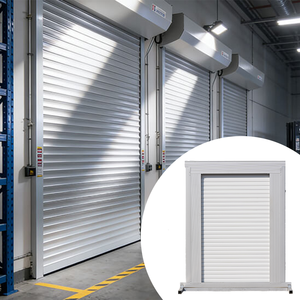
Automatic Fire-Rated Commercial Security Roller Shutter Door
Heavy-duty commercial storefront security closure manufactured with extruded insulated aluminum slats. Features integrated fire-retardant cores, automatic motorization, and emergency manual override systems.
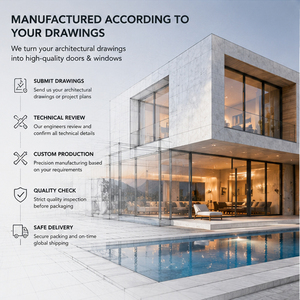
Custom Commercial Storefront Entrance Doors & Glazing
High-traffic architectural storefront entrance system engineered for retail malls, luxury hotels, and commercial towers. Includes continuous heavy-duty hinges, ADA-compliant thresholds, and tempered Low-E glass.
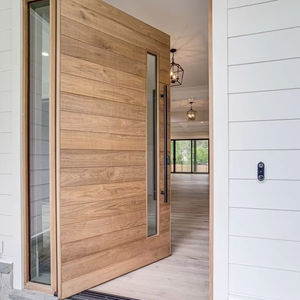
Custom Hybrid Wood-Aluminum Core Architectural Pivot Door
Statement oversized pivot entrance door featuring natural timber veneer bonded to a structural aluminum skeleton. Operates seamlessly on heavy-duty hydraulic floor pivots supporting up to 500kg leaf weights.
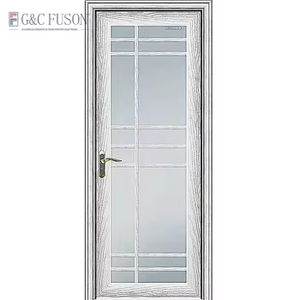
Soundproof Security Casement Entry Door ("Mom & Son" Asymmetrical Leaf)
Dual-leaf asymmetric front entry door designed for luxury estate access. Incorporates acoustic PU core dampening, 5-point security bolt locking, and continuous triple EPDM weather compression seals.
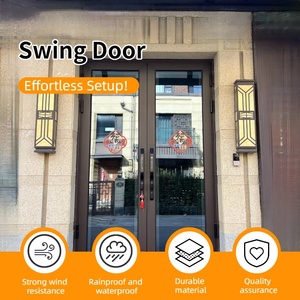
Coastal Minimalist Hurricane-Impact Resistant Exterior Entry Door
Impact-rated swinging exterior door engineered specifically for hurricane zones and coastal environments. Features SentryGlas® laminated safety glass and marine-grade 25-micron anodized aluminum profiles.
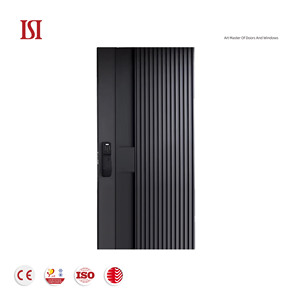
European Armored Anti-Theft Security Door for Luxury Villas
Bespoke European luxury entrance door engineered with internal anti-drill steel reinforcement plates, 3D adjustable heavy hinges, and CNC laser-carved decorative aluminum face panels.
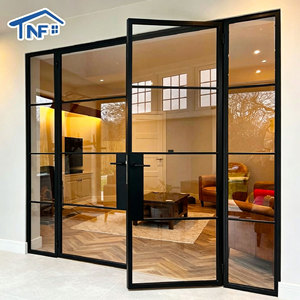
NFRC & AS2047 Certified Thermally Broken French Swing Doors
Dual-certified ultra-energy-efficient exterior entrance door system. Built with 24mm polyamide PA66-GF25 thermal break strips and double Low-E Argon-filled glass units achieving U-factors ≤ 0.24.
Engineering Whitepaper: Technical Specifications & Metallurgical Standards of Custom OEM Designer Doors
In modern architectural design, the exterior front entrance door serves as both the aesthetic centerpiece of the facade and the primary defense line against environmental loads, forced entry, and thermal dispersion. For commercial project developers, architectural specifiers, and global B2B procurement heads, selecting an original equipment manufacturer (OEM) capable of custom extruding, machining, and certifying designer entry doors requires an in-depth understanding of material science, structural dynamics, and thermal isolation physics.
Core Sourcing Principle: High-performance designer entry doors cannot rely on standard fenestration profiles. They demand tailored structural aluminum alloys (6063-T6/6061-T6), multi-chamber polyamide thermal barriers (PA66-GF25), and rigorous international certification (NFRC, AS 2047, CSA, ASTM E330) to meet modern decarbonization and building code requirements.
1. Metallurgy & Extrusion Precision: 6063-T6 vs. 6061-T6 Structural Aluminum Alloy
Aluminum extrusions form the structural skeleton of modern designer front doors. At Fortor Security Door Co., Ltd., raw billet selection is strictly governed by architectural structural load requirements:
- 6063-T6 Aluminum Alloy: The industry benchmark for custom architectural door profiles. Formulated with optimal silicon (0.2–0.6%) and magnesium (0.45–0.9%) concentrations, 6063-T6 provides exceptional surface finish quality, making it ideally suited for high-grade PVDF fluoropolymer coating, anodizing, and wood-grain sublimation processes. It yields an ultimate tensile strength of ≥ 205 MPa and a yield strength of ≥ 170 MPa.
- 6061-T6 Aluminum Alloy: Deployed in high-stress architectural components, such as heavy-duty pivot door stiles, structural corner keys, and oversized commercial storefront framing. Containing higher copper and chromium ratios, 6061-T6 provides a superior yield strength of ≥ 240 MPa, ensuring zero frame warping or sagging on monolithic door leaves exceeding 3.5 meters in height and 500 kilograms in total system weight.
2. Thermal Barrier Technology & Energy Isolation Physics
To prevent conductive thermal bridging across exterior aluminum door frames, high-end OEM manufacturing incorporates advanced thermal break technology. Metal profiles are split into interior and exterior sub-chambers, connected mechanically by structural polyamide strips.
| Performance Metric | Standard Non-Thermal Aluminum Door | Fortor PA66-GF25 Thermally Broken Door | Engineering Benefit |
|---|---|---|---|
| U-Factor (Thermal Transmittance) | 1.10 – 1.35 BTU/h·ft²·°F | 0.22 – 0.28 BTU/h·ft²·°F | Reduces building heating/cooling envelope loss by over 75%. |
| Thermal Barrier Material | None (Direct Metal Contact) | 24mm – 34mm Polyamide (PA66 + 25% Glass Fiber) | High mechanical shear strength matching aluminum thermal expansion. |
| Acoustic Insulation (STC Rating) | 22 – 26 dB | 38 – 45 dB (with Triple Low-E Acoustic Glass) | Dampens exterior traffic, aircraft, and urban sound frequency spectrums. |
| Design Wind Pressure (ASTM E330) | 1,200 Pa (25 PSF) | up to 4,800 Pa (100 PSF / Miami-Dade Rated) | Withstands category 5 hurricane wind loads without permanent deflection. |
3. Surface Finishing Standards: AAMA 2605 PVDF Coating & Anodizing Chemistry
Architectural entry doors are subjected to continuous ultraviolet (UV) radiation, atmospheric humidity, acidic precipitation, and airborne coastal salts. Fortor applies industrial surface finishing standardizations to guarantee decades of color fastness and corrosion resistance:
- AAMA 2605 Superior Performance Organic Coatings: Formulated with 70% Polyvinylidene Fluoride (PVDF) resin. Tested to endure over 4,000 hours of continuous salt spray exposure (ASTM B117) and 10 years of real-time Florida sun exposure without chalking or color fading beyond 5 Delta E units.
- Qualicoat Class 2 Powder Coating: Architectural-grade super-durable polyester powders designed for inland and coastal commercial applications, resisting color shifting and micro-cracking under intense thermal cycling.
- Anodized Marine-Grade Oxide Layers (25 Microns): An electrochemical process that thickens the natural aluminum oxide film. Ideal for coastal luxury resorts, anodizing produces an integral metallic lustre that cannot peel, flake, or blister in salt fog environments.
Enterprise Manufacturing Infrastructure: Fortor Security Door Co., Ltd.
As a premiere China-based OEM/ODM door and window manufacturer operating a state-of-the-art 20,000 square meter production complex in Guangdong, China, Fortor Security Door Co., Ltd. supplies verified B2B importers, real estate developers, facade contractors, and architectural firms across more than 30 countries.
Integrated 20,000㎡ Factory Base
In-house extrusion profile precision cutting, automated CNC hinge milling, glass unit assembly, automated polyurethane foam injection, and 100% pre-shipment structural testing executed under one roof.
Dual International Certification
Door and window series rigorously tested against NFRC, AS 2047, CSA, and ENERGY STAR program criteria, ensuring full compliance for permit applications in the USA, Canada, Australia, and the Caribbean.
Global Logistics & Local Showrooms
Export-ready steel-frame plywood crating engineered for ocean transit. Backed by dedicated US physical showrooms (Hayward, CA) and trusted local installation service partners across 30+ nations.
By keeping CAD shop drawing production, structural engineering calculations, profile anodizing, and multi-point hardware installation strictly within our audited Quality Management System, Fortor eliminates third-party trading markups and guarantees strict adherence to project schedule delivery windows.
Future Procurement & Sourcing Trends in Architectural Designer Front Doors (2026–2030)
The global architectural entrance door industry is undergoing a structural transition driven by strict building performance mandates, urban density noise mitigation demands, smart building automation, and high-end aesthetic customization. B2B procurement managers and real estate developers must align their supply chains with four major technology trends defining the next decade:
1. Seamless Smart Ecosystem Integration & Motorized Mechatronic Hardware
Traditional manual key locks are rapidly giving way to motorized smart lock systems integrated directly into custom door profile cavities during OEM manufacturing. Key developments include:
- Concealed Wire Transfer Hinges & Power Pivots: Electric power transfer (EPT) units built inside heavy-duty pivot axes, delivering low-voltage power to motorized multi-point lock bodies without exposed wiring.
- Biometric & Smart-Home Ecosystem Compatibility: Factory-prepped cutout channels accommodating facial recognition camera modules, biometric fingerprint scanners, encrypted RFID sensors, and Apple HomeKit/Zigbee/Z-Wave IoT communication modules.
2. Ultra-Large Monolithic Formats & Oversized Pivot Door Engineering
Architects are increasingly specifying grand residential and commercial entry doors measuring upwards of 2.0 meters wide by 4.0 meters high. Manufacturing such large-format single leaf doors demands specialized OEM capabilities:
- Self-Balancing Floor Pivot Spring Systems: Heavy-duty hydraulic bottom pivots capable of carrying leaf weights up to 600kg while maintaining smooth fingertip operation and adjustable closing speeds.
- Anti-Bending Tension Rod Systems: Internal adjustable steel tensioning rods embedded within the hollow extrusion profiles to allow site technicians to manually adjust frame straightness and offset natural thermal expansion bending caused by extreme interior/exterior temperature differentials.
3. Decarbonization, Circular Economy & Low Embodied Carbon Sourcing
With international green building codes requiring Environmental Product Declarations (EPDs) and LEED v4.1 certifications, door manufacturers must lower both embodied carbon and operational carbon footprint:
- Recycled Billets & Low-Carbon Smelting: Utilizing primary aluminum smelted using renewable hydro-electric power, reducing embodied carbon metrics below 4.0 kg CO2e per kg of finished aluminum.
- Ultra-Low Thermal Bridge Insulating Inserts: Incorporating expanded polyurethane (PU) or aerogel insulation inside profile hollows to achieve Passive House level thermal ratings (U-values ≤ 0.15 BTU/h·ft²·°F).
4. Extreme Weather Resilience & Climate Adaptation Engineering
As extreme weather events become more frequent globally, coastal and tropical construction markets require entry systems with elevated resilience certificates:
- High Velocity Hurricane Zone (HVHZ) Ratings: Door systems designed with continuous SentryGlas® interlayers to withstand 140 mph missile impact tests (TAS 201/202/203) and cyclic pressure loads without envelope breach.
- Continuous Dual Magnetic Compression Seals: Perimeter gasket lines that utilize magnetic seal attraction to maintain airtight sealing even during severe building displacement or thermal warping.
Comprehensive B2B Procurement FAQ: Technical Guidelines for Overseas Buyers
Below are detailed responses to the most critical technical, compliance, and supply chain questions posed by commercial buyers, architects, and importers when contracting custom OEM door orders with Fortor Security Door Co., Ltd.
Is Fortor a factory manufacturer or a trading intermediary?
Fortor Security Door Co., Ltd. is a direct, verified manufacturer. All profile cutting, CNC machining, thermal break crimping, corner crimping, glass installation, quality control inspection, and protective export packing take place inside our own 20,000 square meter production plant located in Guangdong, China. We invite third-party site auditors and offer live video factory inspections for contract validation.
Which international building performance certifications do your entry doors hold?
Our certified product lines are tested against NFRC (National Fenestration Rating Council), AS 2047 (Australian Standard for Windows and External Doors), CSA (Canadian Standards Association), and ENERGY STAR program guidelines. Tested performance metrics include air infiltration (ASTM E283), water penetration resistance (ASTM E331), structural wind load (ASTM E330), and thermal transmittance U-factors. Official laboratory test reports can be furnished upon request to support local municipal building permit filings.
What degree of customization is available for custom OEM door orders?
We provide 100% full custom manufacturing tailored to your architect's precise CAD/BIM elevation drawings. Customizable parameters include: exact structural frame dimensions, aluminum wall thickness (up to 3.0mm heavy-duty extrusions), profile thermal break depths, surface finish types (AAMA 2605 PVDF, Qualicoat powder coating, anodizing, wood-grain sublimation), glass specifications (double/triple Low-E, acoustic laminated, bullet-resistant, smart electrochromic tint), and hardware cutouts for specified lock brands.
What essential technical project details are required to issue an accurate commercial quote?
To provide a formal, binding engineering quotation, please provide our engineering sales team with: (1) Architectural elevation drawings or rough opening dimension schedules; (2) Door opening configuration types (e.g., single leaf swing, asymmetrical Mom & Son, central pivot, double French); (3) Glass performance requirements (U-factor, SHGC, STC rating); (4) Surface finish color preference; (5) Project city location/wind load zone; and (6) Required compliance standards (NFRC, AS 2047, CE, etc.).
How are door units packaged to ensure damage-free international ocean transit?
Every custom door panel and frame assembly undergoes a multi-layer protective packaging procedure: First, profiles are wrapped with protective anti-scratch PE film and corner plastic guards. Second, units are fully encased in high-density shock-absorbing bubble wrap. Third, products are loaded inside heavy-duty fumigated wooden crates or steel-frame plywood boxes specifically built for forklift handling. Each crate includes moisture-absorbing desiccant packs and container strap anchor rings to prevent shifting during sea freight.
What is your standard production lead time upon shop drawing sign-off?
Standard factory production lead time is typically 25 to 35 calendar days following the final approval of detailed shop drawings and receipt of deposit payment. For custom extrusions requiring specialized new die tooling, allow an additional 12 to 15 days for die fabrication and sample extrusion testing. Fixed delivery windows are provided in your commercial contract to facilitate site schedule coordination.
Can Fortor integrate third-party custom hardware (e.g., Baldwin, Hoppe, Dormakaba, Yale)?
Yes. Our precision multi-axis CNC machines cut lock mortises, hinge pockets, handle spindle holes, and wiring channels directly into aluminum door stiles based on your exact hardware template files. You may either supply hardware sets to our factory for assembly integration or request factory-installed premium hardware from our vetted brand partners (e.g., German Siegenia, HOPPE, GU, or Italian Master hardware systems).
How does Fortor support local installation contractors and handle post-sale warranties?
We provide comprehensive technical installation documentation, 3D exploded assembly diagrams, and step-by-step video tutorials tailored to your door configuration. Remote engineering support is available via real-time video call during critical installation phases. Additionally, overseas project owners can access localized support through our physical US showroom (Hayward, CA) and regional partner networks across North America, Australia, and the Caribbean. All structural frames carry a standard 10-year factory warranty.
Partner with Fortor for Your Next OEM Entry Door Project
Leverage our 20,000㎡ manufacturing base, 17+ years of fenestration engineering expertise, and certified door systems for your upcoming residential or commercial development.