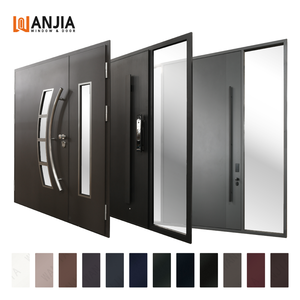
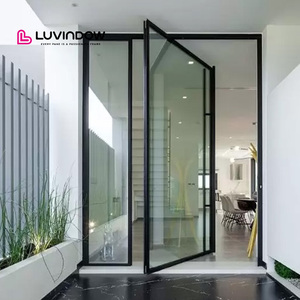
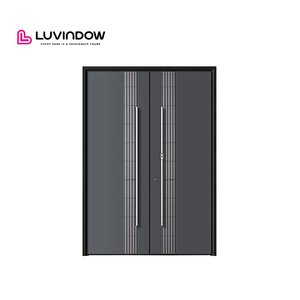
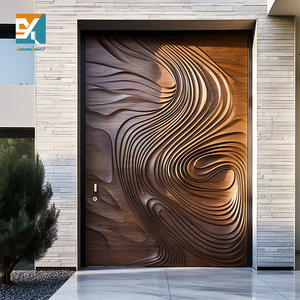
1. Executive Summary & Market Drivers for Modern Aluminium Pivot Doors
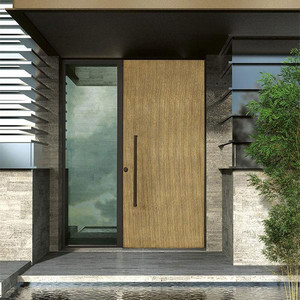
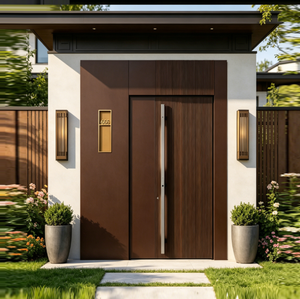
In modern high-end architectural design, the entrance door is no longer merely a functional barrier; it has evolved into a defining statement piece of the building envelope. Modern aluminium pivot doors have rapidly surged in popularity across commercial developments, high-end residential villas, and luxury hospitality projects. Unlike traditional side-hinged doors that transfer panel weight directly onto side door jambs—limiting maximum panel width and total structural weight—pivot door systems rotate on a vertical axis supported by floor-mounted and head-mounted heavy-duty pivot hinges. This structural shift allows architects to specify oversized entrance openings exceeding 3 meters in width and 5 meters in height without compromising smooth operation or structural longevity.
From an OEM/ODM procurement perspective, international developers, facade contractors, and door importers demand suppliers capable of delivering strict tolerances, high structural load resistance, and thermal efficiency. As a leading manufacturer operating out of a 20,000 square meter facility with over 17 years of specialized engineering experience, Fortor Security Door Co., Ltd. provides comprehensive custom manufacturing solutions tailored to international building codes, including NFRC (USA), AS 2047 (Australia), CSA (Canada), and Miami-Dade hurricane impact standards.
Information Gain Insight: The shift toward oversized pivot doors requires moving away from standard 6060 aluminum alloys to structural-grade 6063-T6 aluminum extrusions paired with floor-concealed hydraulic pivots. This combination mitigates sagging risks and guarantees zero structural distortion over a 25-year service life under continuous wind pressure loading.
2. OEM/ODM Engineering Innovations & Structural Architecture
The engineering complexity of modern aluminum pivot doors lies in balancing seamless visual minimalism with extreme structural integrity. OEM and ODM manufacturing requires precise custom tooling, multi-axis CNC machining, and rigorous material science integration.
2.1 Structural Alloy Selection and Profile Extrusion
Fortor utilizes high-tensile 6063-T6 extruded aluminum profiles with nominal wall thicknesses ranging from 2.5mm to 4.0mm in load-bearing zones. Unlike standard residential window profiles, pivot door stiles and rails feature reinforced internal ribbing to resist torsional twisting when operating oversized glass or solid composite panels. Surface treatments include 25-micron anodizing, PVDF fluorocarbon coatings for extreme coastal UV and salt-spray resistance, and realistic heat-transfer wood-grain finishes.
2.2 Heavy-Duty Hydraulic Pivot Mechanisms & Offset Hardware
The heart of any pivot entrance system is the bottom pivot mechanism. OEM engineering incorporates floor-concealed hydraulic self-closing pivot spindles capable of carrying panel loads from 300kg up to 1000kg. Key mechanical features include:
- 360° Rotational Adjustment & Hold-Open Features: Configurable 90° dual-direction hold-open angles paired with soft-closing hydraulic dampers to prevent panel slamming.
- 3D Adjustable Spindle Base: Allows installers to fine-tune panel alignment along X, Y, and Z axes on-site, compensating for minor concrete subfloor variations.
- Concealed Top Pivot Pin: Retractable spring-loaded top pivots installed into the head transom facilitate rapid, safe drop-in panel installation.
2.3 Thermal Isolation, Weather Sealing & Acoustic Engineering
A major historical challenge of oversized pivot doors was air leakage and water penetration around the perimeter. Modern engineering solves this through multi-tiered weatherproofing:
| Engineering Subsystem | Technical Mechanism | Performance Benefit |
|---|---|---|
| Thermal Barrier | Polyamide PA66-GF25 structural thermal break strips (24mm - 34mm depth) | Eliminates thermal bridging; achieves U-Factors ≤ 0.24 BTU/h·ft²·°F |
| Perimeter Weatherproofing | Continuous EPDM gaskets paired with magnetic sweep seals | Prevents air permeability under high wind pressures (Class 4 / EN 12207) |
| Automatic Drop Seal | Concealed spring-loaded bottom drop-down seal actuated by door closure | Seals bottom clearance gap without dragging across finished indoor flooring |
| Acoustic Damping | Multi-chamber profile cavity packed with high-density acoustic insulation | Reduces outdoor ambient noise transfer up to STC 42 dB |
3. Future Procurement & Architectural Trends (2025–2030)
As architectural preferences evolve, B2B procurement managers and project specifiers must align their sourcing strategies with upcoming market demands. Key trend vectors shaping the next decade include:
1. Ultra-Wide Glass & Sidelight Integration
Demand is shifting away from solid metal doors toward floor-to-ceiling glass pivot panels with integrated side lights, utilizing low-iron insulated glass with structural silicone bonding.
2. Smart Access & Motorized Concealed Locks
Seamless integration of motorized multi-point locks compatible with biometrics, facial recognition, keypad access control, and smart-home protocols (Zigbee/Matter).
3. Hybrid Material Cladding (3D Sintered Stone & Wood)
Combining structural aluminum frames with exterior sintered stone panels, real wood timber cladding, or 3D geometric metal tiles for custom luxury facade projects.
4. Hurricane Impact & Extreme Weather Engineering
Coastal developments require DP70+ design pressures and laminated SentryGlas® interlayers to withstand category 5 hurricane wind forces and windborne debris.
5. Low-Carbon Recycled Aluminum Sourcing
Strict European and North American carbon border adjustments (CBAM) make low-carbon recycled aluminum profiles essential for LEED and BREEAM certified projects.
4. OEM/ODM Factory Capabilities & Global Supply Chain Integrity
Partnering with a capable manufacturer is critical when procuring custom architectural systems overseas. Fortor Security Door Co., Ltd. operates as a dedicated original equipment and design manufacturer, eliminating middleman markups and guaranteeing quality control directly at the factory floor.
4.1 Manufacturing Capacity & Facilities
Spanning a modern 20,000 square meter plant in Guangdong, China, Fortor maintains an annual production capacity exceeding 50,000 square meters of high-end doors, windows, sunrooms, and curtain wall systems. Key factory infrastructure includes:
- Automated Double-Head CNC Cutting Centers: Millimeter-accurate profile cutting ensuring seamless 45° and 90° frame joinery.
- Multi-Axis Milling Machines: Precise lock pocket, pivot hinge recess, and drainage hole routing without burrs or profile weakening.
- 100% Pre-Shipment Mock-Up Assembly: Every oversized pivot door is fully assembled, fitted with hardware, tested for swing balance, and inspected for water seal integrity before export packaging.
4.2 Customization Workflow & Engineering Support
Fortor’s dedicated in-house engineering group works directly with developers, architects, and importers through a streamlined 6-stage OEM/ODM program:
- Initial Architectural Review: Analysis of elevation drawings, wall construction details, and wind load targets.
- System Recommendation & Thermal Modeling: Shortlisting optimal profile series (e.g., 75, 80, 95, or 120 series) and glass coatings.
- CAD & 3D BIM Shop Drawing Sign-Off: Generating full technical section drawings detailing frame anchorage, perimeter sealant joints, and pivot offsets.
- Precision Machining & Coating: Extrusion cutting, thermal break assembly, surface anodizing or powder coating.
- Glazing & Factory Assembly: Installation of insulated glass units, hardware integration, and multi-point lock adjustment.
- Steel-Framed Export Crating: Standardized export packaging using fumigated steel-reinforced wooden crates with moisture-barrier wrapping.
5. Frequently Asked Sourcing & Engineering Questions (FAQ)
Key technical and logistics inquiries handled by our engineering sales team for overseas project procurement: