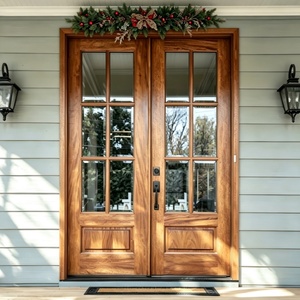
Direct Factory Modern Hinged Aluminum Solid Wood Door Soundproof Triple Tempered Glass Entrance
Acoustic Rating: STC 42 dB
Glazing Unit: Triple Low-E
Alloy Core: 6063-T6 Aluminum
Explore engineered aluminum front door solutions manufactured to NFRC, AS 2047, CSA, and Florida HVHZ compliance. Fully customizable in profile depth, thermal break geometry, security locks, and glass assemblies.
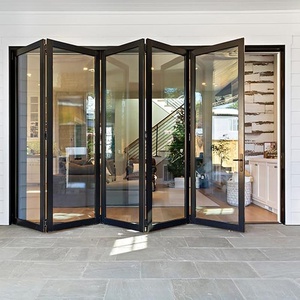
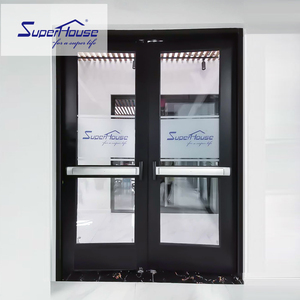
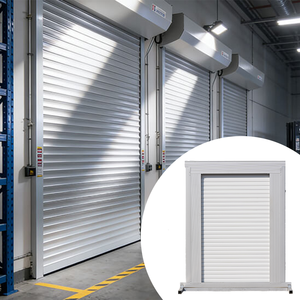
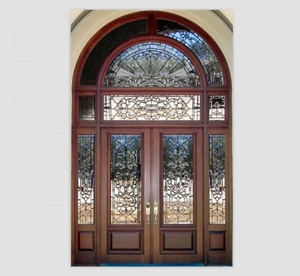
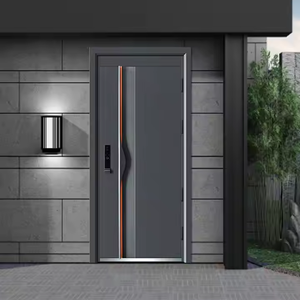
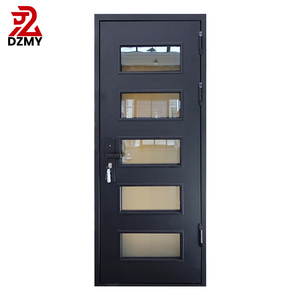
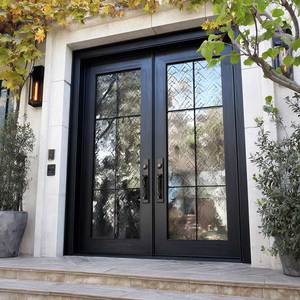
Understanding structural deflection rates, thermal break polymer physics, surface passivation, and multi-point locking mechanisms for international commercial and high-end residential projects.
When evaluating a modern aluminum front door factory, structural integrity begins at the billet alloy composition. Premier manufacturers utilize primary 6063-T6 architectural grade aluminum extrusions for entry door frames and sashes. This alloy strikes the optimal equilibrium between tensile strength (yield strength ≥ 170 MPa) and intricate die-extrusability, allowing for slim sightline profiles with wall thicknesses ranging from 2.0mm to 3.0mm.
Uninsulated aluminum exhibits a high thermal conductivity ($k \approx 200 \text{ W/m}\cdot\text{K}$). Modern energy codes (IECC, California Title 24, European EPBD) mandate strict overall door assembly thermal transmittance values ($U\text{-factor} \le 1.4 \text{ W/m}^2\text{K}$ or $0.25 \text{ Btu/h}\cdot\text{ft}^2\cdot^\circ\text{F}$). To achieve these targets, leading suppliers implement continuous Polyamide PA66-GF25 thermal break struts (25% glass-fiber reinforced nylon).
The thermal expansion coefficient of PA66-GF25 ($2.5 \times 10^{-5}/\text{K}$) matches aluminum extrusions ($2.3 \times 10^{-5}/\text{K}$), preventing shear stress fatigue and structural delamination during severe thermal shock cycles between outdoor sub-zero temperatures and indoor heated spaces.
Standard configurations utilize double or triple pane tempered glass (e.g., 6mm Low-E + 12Ar + 6mm Clear + 12Ar + 6mm Tempered) featuring warm-edge Technoform spacers and 90% Argon gas filling to minimize conductive and radiant thermal transfers.
Analysis of upcoming regulatory shifts, smart hardware integration, passive house demands, and material innovations shaping the international aluminum door market over the next decade.
Global procurement standards are shifting rapidly toward net-zero building energy targets. Future aluminum front door contracts will heavily favor multi-cavity thermal break systems equipped with aerogel insulation infills and quad-gasket perimeter weather seals, achieving overall $U_w \le 0.8 \text{ W/m}^2\text{K}$.
Standalone traditional lock cylinders are being phased out in high-end commercial and residential door specifications. B2B buyers now demand factory-prewired multi-point motorized locks compatible with Matter, Zigbee, Apple HomeKit, and biometric 3D facial recognition systems directly integrated into aluminum sash profiles.
Architects are increasingly specifying entrance openings exceeding 1.8 meters in width and 3.5 meters in height. This drives demand for concealed floor-spring pivot hardware capable of supporting panel weights up to 500 kg while maintaining effort-free operational force (< 15 N).
| System Typology | Structural Profile Depth | Thermal Transmittance ($U$-Value) | Maximum Wind Load Resistance | Security Rating Compliance | Ideal Application Scope |
|---|---|---|---|---|---|
| Hinged Thermal Break Casement | 75mm – 80mm | 1.1 – 1.4 W/m²K | DP70 (3360 Pa) | EN 1627 RC3 / PAS 24 | Luxury Villas, High-End Residential |
| Heavy Architectural Pivot Door | 90mm – 120mm | 1.3 – 1.6 W/m²K | DP65 (3120 Pa) | Multi-Point Hook Locks | Grand Entrances, Hotel Lobbies |
| Alu-Timber Clad Entrance System | 85mm – 105mm | 0.9 – 1.2 W/m²K | DP60 (2880 Pa) | Anti-Burglary C-Class Core | Cold Climate Mountain Residences |
| Commercial Glass Storefront Entry | 100mm – 150mm | 1.6 – 2.0 W/m²K | DP50 (2400 Pa) | Panic Bar Egress Hardware | Retail Boutiques, Office Buildings |
| Hurricane Impact Steel/Alu Door | 80mm – 100mm | 1.4 – 1.8 W/m²K | DP100 (4800 Pa) | Miami-Dade TAS 201/202/203 | Coastal Resorts & High-Velocity Zones |
Direct factory manufacturing strength backing B2B importers, developers, general contractors, and architectural specifiers across 30+ international markets.
Our 20,000㎡ factory operates automated 5-axis CNC profile machining centers, ensuring hinge cutout accuracies within ±0.1mm. Frame corner assembly utilizes hydraulic corner-crimping with dual-component epoxy injection for zero water ingress and long-term frame rigidity.
Fortor door systems undergo rigorous physical testing in certified laboratories. We maintain active compliance documentation for NFRC thermal ratings, AS 2047 Australian structural standards, CSA Canadian codes, ENERGY STAR efficiency benchmarks, and AAMA performance credentials.
All orders are packed in custom IPPC-certified fumigated plywood crates with corner edge-protectors and shrink-wrapped waterproof films. Dedicated sales engineers provide CAD shop drawing confirmation, structural calculations, and installation guidance to North America, Europe, Australia, and the Caribbean.
Clear, technical responses addressing manufacturing credentials, customization parameters, quality verification, and global project delivery.