Technical Whitepaper: Engineering Structural Glass Curtain Walls for Houston Commercial Infrastructure
As the commercial architecture landscape in Greater Houston expands—driven by robust developments across the Energy Corridor, Downtown Houston, the Texas Medical Center, and rapidly growing suburban hubs like Sugar Land and The Woodlands—building envelope performance standards have reached unprecedented levels of technical rigor. Architectural glazing for Houston is not merely an aesthetic gesture; it is a critical thermal and structural barrier engineered to withstand the extreme environmental pressures unique to the U.S. Gulf Coast.
Fortor Security Door Co., Ltd., leveraging a state-of-the-art 20,000 square meter manufacturing infrastructure in Guangdong, China, delivers direct B2B structural glass curtain wall systems designed specifically to surpass Texas building codes (IECC 2021/IBC) and structural load demands. By combining factory-direct efficiency with strict international testing compliance (including NFRC, AS 2047, CSA, and ASTM envelope standards), Fortor serves Houston developers, general contractors, and glazing contractors as a high-reliability engineering partner.
Information Gain Insight: Standard stick-built curtain wall designs often suffer micro-fissuring and seal breakdown under coastal humidity and violent solar radiation cycling. Fortor's engineered unitized and point-supported structural glass systems incorporate dual-sealed silicone structural glazing (SSG) with structural polyamide thermal breaks, cutting solar heat gain coefficient (SHGC) by up to 68% compared to monolithic commercial glass assemblies.
Environmental Engineering Matrix: The Houston Climate Challenge
Designing a commercial structural glass curtain wall serving Houston requires precise mathematical modeling around three dominant climate hazards:
Extreme Subtropical Solar Heat Load
Houston experiences over 200 sunny days annually with summer temperatures routinely exceeding 95°F combined with intense humidity. Glazing systems must incorporate multi-layer Spectrally Selective Low-E coatings (such as triple-silver Low-E on low-iron glass) to maintain a U-factor under 0.28 and SHGC under 0.22.
Hurricane-Force Wind & Impact Resistance
Located within ASCE 7 hurricane wind zones, Houston commercial facades must endure wind pressures exceeding 140 mph (Design Wind Pressure up to ±60 PSF depending on building height). Fortor's systems integrate SentryGlas® (SG) ionoplast interlayers to protect against windborne debris and high-velocity projectile impact.
Differential Thermal Expansion Dynamics
Diurnal surface temperature fluctuations on dark anodized or powder-coated aluminum framing can range up to 80°F in a single 12-hour period. Our precision CNC-machined expansion joints allow micro-movements without degrading the structural silicone seals or compromising water tightness (tested to 15 PSF static water penetration).
Structural Curtain Wall Framing Systems Comparison
Choosing the correct facade architecture impacts not only initial procurement expenditure but also long-term structural integrity, site installation velocity, and building maintenance overhead. Below is an engineering evaluation comparing Fortor's flagship commercial curtain wall typologies tailored for Houston construction requirements.
| System Typology |
Structural Framing Profile |
Thermal Isolation Method |
Wind Load Resistance |
Ideal Houston Application |
| Unitized Structural Glass Curtain Wall |
T6063-T6 Extruded Aluminum Alloy (Structural Wall Thickness 3.0mm+) |
Continuous Polyamide (PA66GF25) Thermal Barrier Strips |
Up to 75 PSF (Custom engineered for high-rise towers) |
High-rise office towers in Downtown Houston, Medical Center facilities, corporate headquarters. |
| Stick Built Glass Facade (Cap/Pressure Plate) |
Heavy-Duty Architectural Aluminum (Mullion Depth 120mm - 200mm) |
EDPM Gaskets with High-Density Insulation Cores |
Up to 50 PSF |
Low-to-mid rise office complexes, retail storefronts, institutional campuses in Katy & Cypress. |
| Point-Supported Spider Glass Wall |
316-Grade Stainless Steel Spider Fittings & Glass Fins / Steel Truss |
Direct Point Isolation Gaskets & Insulating Glass Spacers |
Engineered per Glass Fin Span (Up to 60 PSF) |
Grand atrium entrances, hotel lobbies, luxury car dealerships in Galleria area. |
| Structural Glass Rib / Fin Facade |
Triple Laminated Low-Iron Structural Glass Fins |
Structural Silicone (Dow Corning / Sika 2-Component SSG) |
Up to 65 PSF (Maximum visual transparency) |
Cultural centers, flagship retail, corporate lobbies in Westchase & Woodlands. |
Localized Architectural Trends & Engineering Demand in Houston
The Houston commercial real estate market is undergoing a significant architectural transition. Beyond pure utility, modern developments demand facades that balance ultra-sleek minimalist design with resilient climate defense. Key regional development trends include:
1. Ultra-Clear Low-Iron Vision Glass Lobbies
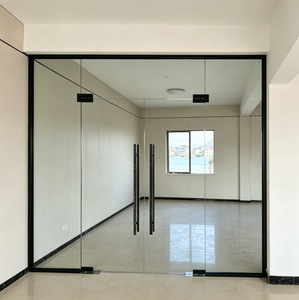
Developers are replacing dated tinted green glass with low-iron structural glass fins and point-supported spider systems to flood multi-story lobbies with natural light while retaining low heat transfer coefficients.
2. Integrated Sun-Shading (Louvers & Fritted Glass)
To meet stringent ASHRAE 90.1 energy mandates adopted across Texas, curtain walls are increasingly specified with factory-integrated exterior aluminum louvers, motorized sunshades, or ceramic frit patterns.
3. Fast-Track Unitized Prefabrication
With local Houston labor costs rising, developers favor unitized structural glass panels pre-assembled and pre-glazed in Fortor's factory, accelerating on-site installation speed by over 40%.
Why Houston General Contractors & Architects Partner with Fortor
As a direct manufacturer with over 17 years of specialized expertise in structural aluminum and glass architectural components, Fortor Security Door Co., Ltd. bridge the gap between high-end architectural customization and factory-direct cost efficiency.
20,000㎡ Modern Production Base
Equipped with European 5-axis CNC machining centers, automated glass insulating lines, and precision corner-crimping equipment ensuring ±0.5mm tolerance on complex facade assemblies.
Verified Testing & Standards Compliance
Our product systems undergo third-party laboratory verification for air infiltration, static/dynamic water penetration, structural performance, and thermal conductivity under NFRC, AS 2047, and CSA guidelines.
End-to-End Export Logistics & Shop Drawings
From complete AutoCAD/Revit BIM detail drawings to export-grade reinforced steel-frame crate packaging, we ensure zero-damage sea transport directly to the Port of Houston or your jobsite.